
You load up the bar, drop into a squat and feel a pinch or tightness in your hip that wasn’t there before.
It might only show up at the bottom. Or it might build as your session goes on. Either way, it leaves you wondering: is this just normal training discomfort, or something you need to fix?
Hip pain when squatting is one of the most common issues we see in athletes. But the cause isn’t always obvious and pushing through it without understanding why it’s happening can lead to longer-term problems.
In this guide, we’ll break down the real causes of hip pain during squats, how to recognise the symptoms, and what you can do to keep training without making it worse.
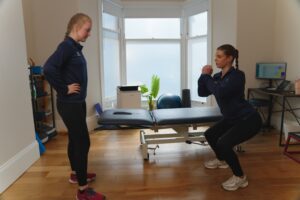
What Causes Hip Pain When Squatting?
Hip pain during squats doesn’t come from one single issue. It’s usually a combination of load, movement quality, and tissue capacity.
1. Hip Impingement is one of the most common causes.
- Feels like a pinching pain in the front of the hip
- Often worse at the bottom of a squat
- Can be linked to reduced hip mobility or joint mechanics
2. Muscle Strains (Hip Flexor or Groin)
- Feels like a pulling or sharp pain
- Often triggered by overload or fatigue
- Common if training volume or intensity has increased quickly
3. Poor Movement Mechanics
This is one of the most overlooked causes of hip pain.
Many athletes focus on strength, but not how their body distributes load during the squat.A common cue is to “push through your heels.” While well-intentioned, this can actually disrupt natural movement.
Your body is designed to shift pressure through the foot as you move:
- Descent → more load toward the heels
- Mid-range → balanced through midfoot
- Ascent → shifting toward midfoot and forefoot
When you keep all your weight in your heels:
- Hip movement can become restricted
- The lower back or front of the hip may take extra stress
- Muscle coordination becomes less efficient
The result: more strain on the hip, less efficient force production
4. Mobility Restrictions
Limited mobility, especially in the hips or ankles, can force your body to compensate.
This often leads to:
- Reduced squat depth
- Forward lean
- Increased stress on the hip joint
5. Overload and Programming Errors
Even with perfect technique, you can still get pain if:
- Training volume is too high
- Recovery is insufficient
- Load increases too quickly
Symptoms of Hip Pain When Squatting
Not all hip pain feels the same. Understanding your symptoms can help identify the cause.
Common signs include:
- Pinching in the front of the hip
- Tightness or pulling during movement
- Pain at the bottom of the squat
- Reduced depth or stiffness
- Clicking or catching sensations
If your pain feels deep and sharp, it’s more likely joint-related.
If it feels like a pull, it’s more likely muscular.
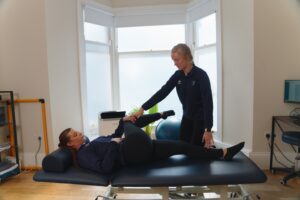
How Range of Motion Affects Hip Pain
Your range of motion plays a huge role in how your body handles load.
If you force depth that your body isn’t prepared for, you increase the risk of:
- Hip impingement
- Muscle strain
- Compensation patterns
Instead of chasing depth, focus on:
- Control through the movement
- Maintaining good alignment
- Working within a pain-free range
Depth should be earned, not forced.
Try Different Squat Variations
Not every squat works for every athlete.
If you’re experiencing hip pain, experiment with:
- Goblet squats (more control, upright posture)
- Box squats (controlled depth)
- Wider or narrower stance
- Heel-elevated squats
The goal isn’t to force one “perfect” technique — it’s to find a variation that allows:
- Smooth hip movement
- Balanced foot pressure
- Pain-free training
Why “Push Through Your Heels” Might Be Causing Your Hip Pain
One of the biggest technical mistakes we see is athletes trying to keep all their weight in their heels.
In reality, efficient movement relies on a flow of pressure through the foot, not a fixed position.
- At the bottom → more heel involvement
- As you rise → pressure shifts toward midfoot
- At the top → movement finishes toward the forefoot
When you lock your weight into your heels:
- You disrupt this natural sequence
- The hips can’t move efficiently
- Other areas (like the lower back or hip flexors) compensate
A better approach is to think: “Stay balanced through the whole foot and let pressure shift naturally.”
This allows your body to:
- Use more muscle groups effectively
- Reduce unnecessary joint stress
- Improve performance and efficiency
How to Prevent Hip Pain When Squatting
Preventing hip pain isn’t just about stretching or strengthening — it’s about how you train.
Focus on:
- Proper warm-ups before lifting
- Gradual progression in load and volume
- Maintaining mobility in hips and ankles
- Training coordination, not just strength
- Avoiding fatigue-driven breakdown in technique
The goal is simple: Move well first, then load it.
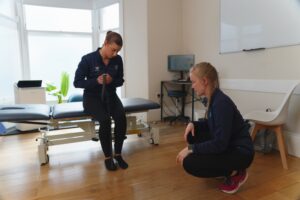
When Should You See a Physio?
You should consider professional help if:
- Pain persists despite modifying training
- You feel pinching, catching, or locking
- Your squat depth or strength is decreasing
- Pain is affecting performance
If you’re unsure what’s causing your hip pain, start with our online assessment to get clarity.
You can also explore our rehab exercises to begin improving movement and strength safely.
For a full diagnosis and treatment plan, book a physiotherapy assessment at one of our Yorkshire clinics.
FAQs
Why does my hip hurt at the bottom of a squat?
This is often linked to hip impingement, limited mobility, or poor load distribution during the movement.
Is hip pain during squats normal?
No. While mild discomfort can happen, persistent or sharp pain is a sign something isn’t working efficiently.
Should I stop squatting if my hip hurts?
Not always — but you should modify your training and avoid pushing through sharp pain.
Can poor technique cause hip pain?
Yes. Poor coordination, load distribution, and movement patterns are some of the most common causes.
Hip pain when squatting isn’t just about tight muscles or weak hips.
It’s usually a combination of:
- Movement quality
- Load management
- Coordination and control
By improving how your body moves — not just how strong it is — you can reduce pain, improve performance, and keep progressing safely.
If you’re unsure what’s causing your symptoms, start with our online assessment, explore our rehab exercises, or book a physiotherapy assessment to get back to training with confidence.
This is part of The Resilient Athlete
The system we use to get athletes moving with confidence again. Here is where to go from this article.
Book an assessment and get a plan built around you.
A generic plan only gets you so far. An online assessment finds the root cause with you and tells you exactly what to do next.