If you’ve ever dealt with ITB syndrome, you know how frustrating it can be. One week you’re running pain-free, and the next the familiar pinch on the outside of your knee returns. Understanding why it keeps coming back is key to finally breaking the cycle.
The Real Culprits Behind Recurring ITB Pain
ITB syndrome isn’t just about a tight band along the side of your thigh. Persistent or recurring pain often comes from system-wide movement issues rather than a local tissue problem alone.
Three major factors influence recurrence:
Hip Control: Weakness or poor activation in the glute medius and lateral hip muscles can let your thigh collapse inward during running. This increases stress on the ITB at its insertion near the knee.
Lateral Knee Stress: Repetitive side-to-side movement or poor knee tracking under load amplifies friction between the ITB and the lateral femoral epicondyle. Even small inefficiencies repeated over hundreds of steps can reignite pain.
Running Mechanics: Foot strike, cadence, stride length, and pelvic stability all feed into the load your ITB absorbs. Inefficient running mechanics can overload the band, even if your hip strength seems adequate.
Why Stretching and Foam Rolling Aren’t Enough
Many athletes rely on stretching, foam rolling, or even topical treatments to “fix” ITB pain. While these may provide temporary relief, they don’t address the underlying movement patterns that cause the band to repeatedly irritate. Without correcting hip control, knee tracking, and running mechanics, the pain often returns.
How Our Physiotherapy Approach Helps
At our clinic, our physiotherapists take a system-wide approach to ITB syndrome. We don’t just treat the knee — we look at the entire kinetic chain: hips, core, glutes, and lower limb alignment.
Our method includes:
- Assessing hip and glute strength, activation timing, and coordination
- Evaluating running mechanics and how your knee moves under load
- Identifying patterns that increase lateral knee stress and ITB friction
- Designing a progressive plan to restore load tolerance, improve control, and reduce recurrence risk
By addressing the root causes, we help athletes return to running, lifting, and daily life without being trapped in the ITB pain cycle.
When ITB Pain Needs a Specialist
Some symptoms signal that ITB pain may not be the whole story, or that intervention needs to be more urgent:
- Persistent sharp pain at rest or during daily activities
- Locking, catching, or swelling in the knee
- Pain that doesn’t improve after several weeks of load management and basic rehab
If you experience these, it’s time to see a physiotherapist or sports medicine doctor to rule out other issues, such as lateral meniscus irritation or ligament involvement.
Get the Basics Right
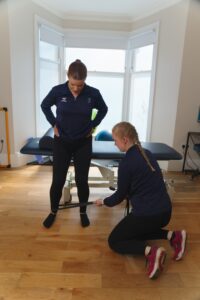
Even mild ITB friction responds best when you focus on foundational principles. Instead of thinking only about the band itself, start with system-wide movement awareness. Paying attention to hip activation, knee alignment, and load distribution helps your body adapt safely and reduces stress on the ITB over time.
Key principles to keep in mind include:
- Hip and Core Coordination – Engage glutes and lateral hip muscles in a way that supports proper thigh and knee positioning.
- Gradual Load Adaptation – Increase mileage, intensity, or side-to-side movements in controlled increments to allow tissues to tolerate stress.
- Integrated Movement – Think of your knee, hip, and core as a connected system. Efficient tracking and force distribution matter more than stretching or rolling the ITB.
Following these principles lays the groundwork for recovery, helping prevent the pain from coming back. For a clear starting point, explore our ITB Self-Assessment page, or book a physiotherapy appointment to identify the best individualised approach.
This is part of The Resilient Athlete
The system we use to get athletes moving with confidence again. Here is where to go from this article.
Book an assessment and get a plan built around you.
A generic plan only gets you so far. An online assessment finds the root cause with you and tells you exactly what to do next.