
You roll your ankle. You rest. You rehab. It settles.
Then a few weeks or months later, it happens again.
Whether you’re a professional athlete or someone who just wants to train consistently, recurring ankle sprains are one of the most frustrating injuries to deal with. It’s not just the pain—it’s the uncertainty. You start to question your movement, your training, and whether your ankle is ever really “fixed.”
At our Yorkshire clinics, we see this pattern all the time. From elite athletes to everyday gym-goers, the story is the same: the pain goes away, but the problem doesn’t.
And that’s the key.

Why Ankle Sprains Keep Coming Back
Recurring ankle sprains are rarely just about the ligament itself. They’re usually the result of how your body handles load, how it coordinates movement, and how force is distributed through your foot and ankle.
1. Poor Load Management
Most people return to training too quickly.
Pain settles, swelling reduces, and it feels “fine”, so you go back to running, lifting, or sport. But the tissue hasn’t rebuilt its capacity to handle load yet.
Pain going away doesn’t mean the ankle is ready.
Without gradually rebuilding load tolerance, the same structures get overwhelmed again, and the cycle repeats.
2. Loss of Coordination (The Missing Link)
After an ankle sprain, your body adapts.
It has to. You still need to move, train, and function. So it creates workarounds—subtle changes in how you walk, balance, and push off.
A simple way to think about it:
When one “rower” gets injured, the rest of the team adjusts to keep the boat moving. But if that pattern isn’t reset, it becomes the new normal—even after the injury has healed.
You might stop limping, but the system underneath hasn’t fully returned to normal. The ankle becomes less reactive, less stable, and slower to respond under load.
That’s where reinjury risk builds.
3. Poor Foot Pressure & Lateral Stability
Your ankle doesn’t work in isolation.
It relies heavily on the muscles around it—especially the peroneals—to control lateral stability and manage force through the foot.
If these aren’t functioning properly:
- The ankle becomes less stable under load
- Force isn’t distributed efficiently
- The same structures get overloaded again
This is one of the biggest drivers of chronic ankle instability—and one of the most overlooked.
Healed vs Fully Recovered
This is where most people get caught out.
“Healed” simply means the pain has settled and the swelling has gone down.
But full recovery is something very different — it means your ankle can handle load again, your coordination has been restored, and you can tolerate real movement demands without breaking down.
Most people stop at “healed.” That’s why the injury keeps coming back.
What Is Chronic Ankle Instability?
Chronic ankle instability is what happens when the system never fully resets after an injury.
It shows up as:
- Repeated ankle “rolling”
- A feeling of instability or lack of trust
- Difficulty balancing or controlling movement
- Ongoing tightness or discomfort
At our clinics, we often see athletes months—or even years—after their initial sprain still dealing with instability. Not because the ligament hasn’t healed, but because the movement system around it hasn’t been restored.
Left unaddressed, chronic ankle instability doesn’t just affect your ankle. It changes how load travels up the entire kinetic chain. The knee compensates. The hip compensates. Lower back pain, knee problems, and hip issues that seem unrelated often trace their origin back to an ankle that was never properly rehabilitated years earlier.
Common Rehab Mistakes That Keep You Stuck
Even with good intentions, most rehab programmes miss key pieces.
We see the same patterns repeatedly:
- Rushing back into training without rebuilding load tolerance
- Over-relying on basic strength work without progressing it
- Ignoring lateral stability, especially the peroneals
- Focusing on isolated exercises instead of real movement
- No structured progression back into sport or training
These approaches aren’t wrong—but they’re incomplete.
What Actually Fixes It
Recovery isn’t about doing more exercises—it’s about doing the right things, in the right order.
1. Restore Load Tolerance
Gradually rebuild your ankle’s ability to handle force. Not spikes. Not guesswork. Controlled progression.
2. Rebuild Lateral Stability
Target the muscles that actually stabilise the ankle—especially the peroneals—and retrain control in real positions.
3. Restore Coordination
This is where most people fall short. Strength alone isn’t enough. Your body needs to relearn how to move efficiently under load, fatigue, and speed.
The goal isn’t just stronger muscles—it’s a system that works together again.
Exercises That Actually Help
The most effective rehab focuses on restoring stability, control, and load tolerance together. Rather than listing everything here, you can explore our full exercise library with step-by-step guidance.
Start With a Self-Assessment
If your ankle keeps rolling or never feels quite right, the first step isn’t guessing—it’s understanding what’s actually driving the problem.
Start with our self-assessment to identify:
- Whether you have instability
- How well your ankle handles load
- What needs to be addressed first
From there, you can follow a structured plan that actually moves things forward.
When Should You See a Physio?
Some ankle sprains are minor and settle with good self-management, but there are clear signs you need a proper assessment.
If you’ve sprained the same ankle more than once, it still feels unstable weeks later, you rely on taping or bracing every session, or you’ve started subtly changing how you move to protect it, that’s a red flag. Pain or stiffness affecting training quality, not just comfort is another.
The earlier you address it, the easier the rehab tends to be. Long-standing instability can still be improved, but it usually requires more time and a more structured approach to loading.
The ProSport Physio Approach
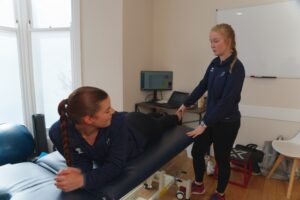
At our Yorkshire clinics, we treat professional athletes and everyday clients using the same principles, because how your body handles load doesn’t change.
We don’t just treat pain. We assess:
- How your body distributes load
- How your ankle functions under movement
- Which muscles are overworking—and which aren’t contributing enough
Our goal is to build a system that can handle training, competition, and real-life demands without breaking down.
A Final Thought
“Your body creates temporary workarounds to keep you moving after injury. But if those patterns aren’t reset, they become permanent—and that’s where recurring problems begin.”
That’s the difference between short-term recovery and long-term resilience.
Ready to Fix the Root Cause?
If your ankle sprain keeps coming back, don’t just wait for it to settle.
Start with a self-assessment, explore structured rehab exercises, or book a physiotherapy session and take the first step toward stable, confident movement again.
FAQs
Should I stretch a sprained ankle?
Gentle movement is fine once the acute phase settles, but avoid aggressive stretching early on as it can stress healing ligaments. As recovery progresses, restoring ankle mobility, especially dorsiflexion, becomes important for stability.
Can I run with a previously sprained ankle?
Yes, but only with a gradual return. Build from walking to running while managing volume and intensity. If the ankle feels unstable at any point, it’s a sign to step back and address it rather than push through.