
The Question Every Athlete Asks
You’ve sprained your ankle. It’s painful, swollen, and you’re already thinking about missed sessions and lost progress.
Should you rest it, push through, or keep training in some way?
This is one of the most common questions we see and getting it wrong can delay recovery or turn a short-term issue into a long-term problem. The key isn’t choosing between rest or rehab, but knowing what to load, when, and how much.
Why This Decision Is Harder for Athletes
For a non-athlete, “rest the ankle for a week” is straightforward advice. For an athlete, it lands differently.
There’s the training block you’ve been building for months. The competition that’s been in the diary since January. The fear that a week off becomes two, becomes a month, becomes a fitness hole you can’t climb out of. The identity pressure of being someone who trains, and the discomfort of suddenly not being that person.
We see this tension every week. And we understand it, because pushing through short-term discomfort is often exactly what athletic performance requires. The problem is that an ankle sprain isn’t short-term discomfort. It’s a structural injury with a specific biological healing process, and that process doesn’t compress just because your calendar says it should.
The athletes who navigate this best are the ones who replace the binary rest-or-train question with a better one: what can I load right now that moves recovery forward without setting it back?
The Cost of Getting It Wrong in Either Direction
Too Much Rest
Complete rest after an ankle sprain, beyond the initial phase, is rarely the right approach. Ligaments don’t just heal with time, they respond to controlled loading. The right amount of stress helps the tissue repair and organise properly, whereas doing nothing for too long can leave it weaker and more vulnerable.
At the same time, your proprioception, your ankle’s ability to sense position and react, quickly declines without use. So even if the tissue improves, the system that protects you during movement falls behind.
Then there’s the psychological cost. Athletes who avoid loading the ankle for too long begin to treat it as fragile, modifying movements, hesitating on direction changes, subconsciously offloading through the joint in ways that compromise both performance and long-term stability. That protective relationship with the ankle can persist long after the tissue has healed.
Too Much Load, Too Soon
The opposite mistake is just as common: returning too soon. Athletes often feel fine at low levels, but the ankle hasn’t rebuilt the capacity for high-speed, high-impact movements like sprinting, landing, or changing direction.
That’s when it fails. And the second sprain is often worse than the first.
Returning too soon doesn’t just risk re-injury, it compounds the problem. It’s not luck; it’s what happens when the joint is loaded before it’s ready.
The Framework: What Grade Are You Dealing With?
The right balance of rest and rehab depends on how severe your sprain is. If you’re unsure which grade you have, check out our full guide on Grade 1, 2, and 3 ankle sprains for a detailed breakdown. Generally, milder sprains need only a short protective phase before progressive rehab, while more serious sprains require longer, carefully managed loading and professional assessment.
What “Active Recovery” Actually Means
The middle ground, which is where most athletes with ankle sprains should actually be, is active recovery. Not rest. Not full training. Purposeful, structured activity that maintains fitness, supports healing, and progressively rebuilds the ankle’s capacity.
In practice, active recovery after an ankle sprain might look like this:
Upper body and core training can typically continue immediately after any grade of sprain, provided it doesn’t require lower limb loading that stresses the ankle. Seated or lying exercises, upper body pressing and pulling, core stability work — none of these compromise ankle healing and all of them maintain the training stimulus your body is used to.
Non-impact cardiovascular work — pool running, swimming, or cycling on a stationary bike — can usually be introduced within the first week for Grade 1 and 2 sprains, and shortly after for Grade 3 once weight-bearing is more comfortable. This is one of the most underused tools in athlete ankle rehab. The cardiovascular and psychological benefit of maintaining some form of conditioning work during recovery is significant.
Progressive ankle loading begins with gentle range-of-motion exercises and weight-bearing as tolerated, advancing to balance and proprioception work, then to strength work, and eventually to sport-specific movement. Each phase earns the right to progress to the next — not on a fixed timeline, but based on how the ankle is responding. → Our ankle rehabilitation exercise library provides grade-appropriate progressions you can start working through immediately.
Red Flags: When to Stop and Get Assessed
There are situations where attempting to self-manage and push into active recovery is the wrong call. The following are signs to seek a physiotherapy assessment rather than working through it independently:
- You cannot bear weight at all, or weight-bearing is severely painful
- Swelling is extensive and developed rapidly after the injury
- There is significant bruising extending toward the foot or up the lower leg
- You heard or felt a distinct pop or snap at the moment of injury
- The ankle feels completely unreliable or like it cannot support any load
- Symptoms are not improving meaningfully after five to seven days of appropriate management
- This is a recurrent sprain on the same ankle and instability is increasing
The last point is important. If you’ve sprained the same ankle before and this one feels worse, the picture is more complex than a straightforward acute injury. Chronic instability changes the rehabilitation approach and continuing to load without addressing the underlying deficit is how persistent problems develop.

The Psychological Side Nobody Talks About
In sport, training is tightly tied to identity. For many athletes, an injury feels like losing a piece of who they are.
That psychological pressure creates two opposing problems. For some athletes, it drives a premature return, training through pain because rest feels like weakness, or because competition pressure overrides clinical sense. For others, a significant sprain creates fear, a hyperawareness of the ankle, hesitancy in movements that used to be automatic, a subtle avoidance of the situations where the original injury happened.
Both patterns interfere with recovery. The athlete who rushes back loads tissue that isn’t ready. The athlete who becomes fearful of the ankle never rebuilds the confident, unrestricted movement that full performance requires.
What we work toward in the clinic is a clear performance goal, not “avoid re-injury,” but “move with full confidence and power.” That shift in focus changes what the nervous system organises around. It moves the athlete from a protective, avoidant pattern toward a progressive, performance-oriented one. And that shift, it turns out, is as important to long-term recovery as the exercises themselves.
Sport-Specific Considerations
Different sports create different demands, and active recovery should be shaped around what your sport actually requires.
Runners can typically maintain upper body and core work immediately, introduce pool running or cycling early, and return to flat, predictable running surfaces before progressing to trail, track, or road running with direction changes. The return to running should be graduated, walking to jogging to running, with session volume and surface complexity increasing separately, not simultaneously.
Court and field sport athletes (football, rugby, basketball, netball) face the additional challenge that their sport involves rapid direction changes, unpredictable surfaces, and contact, all under fatigue. Returning to full training before reactive stability and multi-directional load tolerance have been rebuilt is particularly high-risk in these sports. Structured return-to-sport testing before resuming full contact or competitive play is strongly advisable.
Gym-based athletes and CrossFit athletes need to think carefully about which movements are genuinely ankle-loading and which aren’t. Upper body work, many pulling movements, seated or machine-based exercises — these can continue. Olympic lifting, box jumps, running workouts, and any single-leg loading need to be reintroduced progressively and with attention to how the ankle responds.
When Should You See a Physio?
You don’t always need a physiotherapy assessment to manage a mild ankle sprain. But you do need one if:
- The injury is Grade 2 or above and you have a competition or event within the next four to six weeks
- You’ve had repeated sprains on the same ankle
- You’re unsure of the grade and the ankle feels genuinely unstable
- Symptoms haven’t improved meaningfully within a week of appropriate self-management
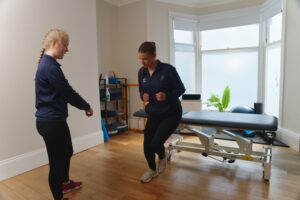
- You want a structured, progressive return-to-sport programme rather than guesswork
Early assessment doesn’t slow you down. Done right, it’s the thing that keeps you on the fastest possible path back to full performance.
Book an assessment at our Yorkshire clinics and we’ll establish exactly where you are, what the ankle needs, and how to build back without compromising what you’ve worked for.
Rest is not the default answer to an ankle sprain. Neither is pushing through and hoping for the best.
The right answer is active, progressive, well-judged loading — the kind that supports healing, maintains fitness, rebuilds the specific capacities the ankle lost, and respects the timeline that the biology of tissue repair actually requires.
Athletes who approach ankle sprains this way don’t just recover faster. They come back with a more robust, more stable joint than they had before the injury. And that’s a better outcome than simply waiting for the pain to go away.
FAQ
Can I train with a sprained ankle?
In most cases, yes — but not all training is appropriate. Upper body and core work can usually continue immediately. Non-impact cardiovascular training can be introduced early. Lower limb loading should be progressive and guided by the grade of the sprain and how the ankle is responding. Training through significant pain or instability without assessment is not advisable.
Will I lose fitness if I rest my ankle?
Some deconditioning is inevitable with any injury, but the impact is far smaller than most athletes fear — particularly if upper body training and non-impact cardiovascular work continue throughout recovery. The bigger fitness risk is an inadequate rehabilitation that leads to re-injury, pulling you out of training repeatedly over months or years.
Is it bad to walk on a sprained ankle?
For Grade 1 and most Grade 2 sprains, weight-bearing and walking as tolerated is generally appropriate and beneficial. Forced weight-bearing through severe pain is not. If walking is very difficult or painful, a brief period of reduced weight-bearing with support may be necessary — but this should be assessed rather than assumed.
This is part of The Resilient Athlete
The system we use to get athletes moving with confidence again. Here is where to go from this article.
Book an assessment and get a plan built around you.
A generic plan only gets you so far. An online assessment finds the root cause with you and tells you exactly what to do next.