
You’ve been feeling it for a while, a deep ache in the buttock that flares during a run, tightens after cycling, or makes heavy squats feel risky. Sometimes the pain radiates down the leg, and sometimes it just sits there, dull and persistent.
“Buttock pain” is not a diagnosis; it’s a postcode with several very different residents. At our Yorkshire clinics, we see this misidentified constantly in both professional athletes and recreational gym-goers. The confusion comes from anatomy. The glutes and piriformis share the same neighbourhood, and when either is unhappy, the symptoms can look almost identical.
The important point is that each responds to different treatments, and using the wrong approach can make things worse. Knowing which one is causing your pain is essential.
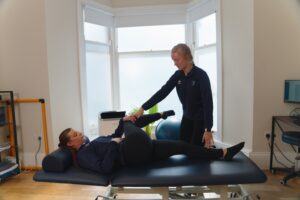
The Anatomy You Need to Understand
You don’t need a degree in anatomy to make sense of this — but a basic picture helps.
The glutes make up the large muscles around the rear of the hip and consist of three key parts: the gluteus maximus, which powers hip extension for sprinting, jumping, and squatting; the gluteus medius, which stabilises the pelvis during single-leg movements; and the gluteus minimus, which assists with hip stability and rotation. Together, they control force transfer, pelvis stability, and lower-limb load, protecting the knee, hip, and lower back.
The piriformis is a small, deep muscle running from the sacrum to the top of the femur. Its main role is hip external rotation, but its close relationship with the sciatic nerve means irritation can cause pain that radiates down the leg.
Why Athletes Are Particularly Vulnerable
Both structures are under significant demand in almost every sport, which helps explain why this type of pain is so common among athletes.
Runners are particularly prone to piriformis irritation. The repetitive hip rotation involved in the running gait, combined with high mileage and the fatigue-related breakdown in hip mechanics that occurs later in long runs, creates the conditions for the piriformis to become overloaded. When the glutes are fatiguing and not fully stabilising the pelvis, the piriformis is forced to compensate — and compensation under load, over thousands of repetitions, leads to irritation.
Weightlifters and CrossFit athletes more commonly present with glute strains — particularly of the gluteus maximus — from heavy hip hinge work, squatting, or explosive movements where the glute is under high eccentric load. A sudden sharp pain during a heavy deadlift or a box jump that catches you off guard is a common story in this population.
Cyclists experience a different pattern. Prolonged hip flexion in the saddle shortens the hip flexors and reduces the mechanical advantage of the glutes, while the piriformis is placed under sustained tension. Deep buttock tightness that builds over the course of a long ride — and stiffens significantly after — is a familiar complaint in our clinic from both amateur and competitive cyclists.
Football and court sport athletes deal with the combination of rapid rotation, acceleration, deceleration, and prolonged loading that stresses both structures simultaneously, often making the distinction harder to establish without proper assessment.
Symptoms: How to Tell What You’re Dealing With
The overlap between these two conditions is real, but there are distinguishing features worth knowing.
| Symptom | Glute Pain | Piriformis Pain |
|---|---|---|
| Pain location | Superficial buttock or lateral hip | Deep buttock, near the sacrum |
| Radiating symptoms | Rare | Often down the back of the leg |
| Tingling or numbness | Uncommon | More common, particularly with sitting |
| Pain triggers | Squats, lunges, jumping, hip extension | Sitting, crossing legs, running, pivoting |
| Response to stretching | Usually provides relief | Sometimes worsens symptoms |
| Morning behaviour | Stiff but eases with movement | Often worse after prolonged sitting |
A few patterns can help distinguish the source of your pain. Muscle ache triggered by hip extension (squats, deadlifts, stairs) usually points to the glutes. Pain that appears with prolonged sitting, crossing the legs, or hip rotation, especially if it radiates toward the back of the thigh, suggests the piriformis. Numbness, tingling, or shooting pain down the leg may indicate sciatic nerve involvement and should be assessed by a physiotherapist or sports medicine clinician before attempting self-tests or rehab.
Simple Self-Tests to Help Identify the Source
It can be tricky to know whether pain in the hip and glute region is coming from the glutes or the piriformis. Rather than trying to guess with individual tests, a structured self-assessment gives a clearer picture of which structure is likely involved. This approach helps you understand your symptoms, highlights areas that may need targeted work, and points toward the safest next steps.
Our self-assessment is designed specifically for athletes dealing with deep hip or glute-region pain. It walks you through a step-by-step screening process, helping you see patterns in your movement, pain triggers, and muscle function. Think of it as a roadmap for recovery rather than a single test — it’s the starting point for directing your rehab and reducing the risk of chronic issues.
→ Start your self-assessment here.
What Comes Next: Why Getting This Right Matters
The reason we’re specific about the distinction between these two structures isn’t academic. It’s because the rehabilitation approach is different — and applying the wrong one can delay recovery significantly.
Glute pain generally responds well to progressive strengthening once the acute phase has settled. The tissue needs to be loaded, not avoided. Prolonged rest without rehabilitation leads to further weakness and the compensation patterns that caused the problem in the first place.
Piriformis irritation — particularly where there’s sciatic nerve involvement — needs a more careful approach. Aggressive stretching into the piriformis when the sciatic nerve is sensitised can aggravate symptoms rather than relieve them. The initial focus is often on reducing nerve irritation before progressive loading is introduced.
In both cases, the underlying driver — whatever created the conditions for this injury to develop — needs to be identified and addressed. Glute medius weakness that overloads the piriformis. A hip mobility restriction that alters load distribution through the squat. A training spike that exceeded tissue capacity. These are the root causes, and treating the symptom without addressing them is how these problems become chronic.
→ Our exercise library includes targeted rehabilitation programmes for both glute and piriformis presentations — with progressions appropriate for athletic populations.
When to See a Physio
Self-assessment and structured exercise have a genuine role in managing this kind of presentation — but there are clear signs that in-person assessment is the right next step:
- Symptoms haven’t improved after two to three weeks of appropriate self-management
- You’re experiencing numbness, tingling, or radiating pain below the knee
- Weakness in the hip or leg is affecting how you move or train
- The pain is worsening rather than improving with activity modification
- You’ve had this before and it keeps coming back
Recurrent deep buttock pain that follows the same pattern across multiple training cycles is almost always a sign that the underlying movement or load issue hasn’t been properly addressed. Each recurrence tends to take longer to settle than the last.
Early assessment is considerably more efficient than managing a chronic presentation that’s had months to become entrenched.
Deep pain in athletes is rarely straightforward and almost never random. Both the gluteal muscles and the piriformis are heavily loaded in most sports, and when either is overloaded, symptoms can overlap, making self-diagnosis tricky. The key is not to manage it blindly. Identifying the source, understanding what caused the issue, and following a structured rehabilitation programme specific to your situation is what separates a short recovery from a long-term problem.
→ Start with our self-assessment to get a clearer picture and next steps.
Or book an assessment at one of our clinics to work through it with one of our physiotherapists.
Frequently Asked Questions
How do I know if it’s piriformis syndrome or a glute strain?
Glute strains usually hurt in the muscle during hip-loading movements like squats or hip extension. Piriformis pain is deeper, often worsens with sitting or hip rotation, and can radiate down the leg. Self-tests give clues, but a physiotherapy assessment is the most reliable way to tell.
Can piriformis pain cause sciatica?
Yes, piriformis irritation can affect the sciatic nerve, causing pain, tingling, or numbness down the leg. True sciatica comes from the lower spine. Any radiating symptoms should be assessed clinically rather than managed on your own.
Should I stretch my piriformis if it’s painful?
Not aggressively. Stretching can worsen symptoms if the sciatic nerve is involved. Gentle movement may help, but a professional assessment will show whether stretching is safe or counterproductive.
Can weak glutes cause piriformis problems?
Yes. Weak glutes, especially the gluteus medius, force the piriformis to compensate, which can lead to irritation and tightness. Strengthening and coordinating the glutes is a key part of effective rehab.
This is part of The Resilient Athlete
The system we use to get athletes moving with confidence again. Here is where to go from this article.
Book an assessment and get a plan built around you.
A generic plan only gets you so far. An online assessment finds the root cause with you and tells you exactly what to do next.