For many of the athletes we treat at our Yorkshire clinics, the most frustrating part of an injury isn’t the pain—it’s the fear of losing progress. If you are dealing with Achilles discomfort, your first instinct might be to stop everything. However, complete rest is rarely the answer for tendon health.
The real question isn’t “Should I stop?” but rather, “How can we modify your load?”.
In this post, we’ll explore how to navigate squats, lunges, and running without further aggravating the tendon.
Tendon Irritation vs Achilles Tendonitis: What’s the Difference?
Not all Achilles pain is the same — and this is where many athletes get it wrong.
Before modifying your programme, it is vital to understand what is happening under the surface.
We often categorise Achilles issues into two stages:
- Reactive Tendinopathy (Mild Irritation): This is usually a sudden response to an increase in load. The tendon may swell slightly but hasn’t undergone structural changes. It often settles quickly with a brief 3–5 day period of load reduction.
- Achilles Tendonitis/Tendinopathy: This involves more persistent changes to the tendon tissue. The pain is often “grumpy” in the morning or at the start of a run, but may “warm up” and feel better mid-session—only to ache significantly afterwards.
This distinction matters because how you train should change depending on where you are on that spectrum.
Can You Do Squats with Achilles Tendonitis?
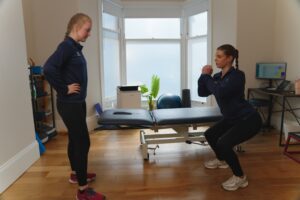
Squats place significant demand on the calf-Achilles complex, particularly at the bottom of the movement where ankle dorsiflexion increases (toes moving toward the shin). If your tendon is already sensitive, forcing deep or heavy squats can aggravate symptoms.
Instead of avoiding squats altogether, the goal is to modify them so you can keep training without flaring things up.
For example:
- Reducing depth to stay within a pain-free range
- Using a heel-elevated position to reduce tendon strain
- Slowing tempo to improve control
- Managing load (lighter weight, higher control)
The aim isn’t to stop training — it’s to train within your tendon’s current capacity.
Modifying Lunges and Calf Raises
Maintaining strength is the cornerstone of Achilles tendon physiotherapy. We don’t want the surrounding muscles to atrophy, as this leaves the tendon even more vulnerable.
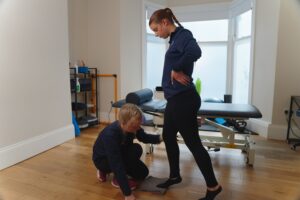
- Lunges: Switch from forward lunges (which have a high braking force) to reverse lunges or split squats. These are generally much more tolerable for a reactive Achilles.
- Calf Raises: If full-range calf raises hurt, we start with isometrics. Holding a mid-range calf raise for 30–45 seconds can actually have an analgesic (pain-numbing) effect on the tendon.
Can You Run with Achilles Tendonitis?
This is one of the most common questions we get: Can I keep running if I have Achilles pain?
The answer is: it depends on your symptoms and how your tendon responds to load.
Rule this out first. If your Achilles pain came on suddenly, felt like a sharp blow or like being kicked in the back of the leg, and you cannot push off or rise onto your toes, do not train through it. That can signal a tendon tear and needs urgent assessment.
If your pain:
- Stays mild (e.g. 2–3/10)
- Improves as you warm up
- Settles within 24 hours
…then running may still be appropriate — with modifications.
However, if your Achilles hurts after running, becomes progressively worse, or affects your stride, continuing to run without adjusting your training will likely delay recovery.
In these cases, reducing volume, avoiding hills or speed work, and temporarily lowering intensity can help maintain fitness while allowing the tendon to settle.
How to Modify Training Without Losing Strength
One of the biggest fears athletes have is losing strength or fitness while dealing with injury. But with the right approach, you can maintain — and even improve — performance.
Rather than removing load completely, we focus on controlling and directing it properly.
Exercises like calf raises, split squats, and controlled isometrics can help maintain strength while gradually rebuilding tendon capacity.
The key is not just the exercises themselves, but how well you control and tolerate the load.
This is where many rehab programmes fall short — they focus on strength but not how the tendon and surrounding muscles work together under load.
Gradual Return to Running: What Works
Returning to running too quickly is one of the main reasons Achilles pain becomes chronic.
Instead of jumping straight back into your usual routine, a graded progression works far better. This might involve:
- Starting with shorter, lower-intensity runs
- Increasing volume gradually (not all at once)
- Monitoring how your Achilles responds over the next 24–48 hours
A useful rule: your tendon should feel no worse the next day. If it does, you’ve likely done too much, too soon.
Building back gradually allows your tendon to adapt — rather than react.
The Role of Physiotherapy in Achilles Pain
If your Achilles pain is lingering or keeps returning, this is where Achilles tendon physiotherapy becomes essential.
At our clinic, we don’t just treat symptoms, we assess:
- How your body distributes load
- Which muscles are overworking or underperforming
- How your movement patterns are affecting the tendon
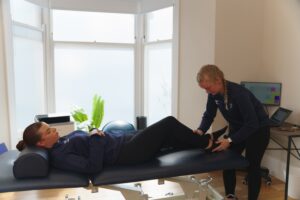
Hands-on treatment (including sports massage) can reduce tension and improve mobility. The long-term goal is improving load tolerance and restoring efficient movement — not just reducing pain.
When Should You Stop and Get Help?
You should seek professional guidance if:
- Your Achilles pain is worsening
- It hurts after running consistently
- Morning stiffness is increasing
- You’re changing how you move or train because of pain
These are signs your tendon isn’t coping with load — and continuing without a plan may prolong recovery.
Achilles tendonitis doesn’t automatically mean you have to stop running or squatting — but it does mean you need to be smarter about how you train.
The key is understanding:
- What stage your injury is at
- How your tendon responds to load
- How to modify training without removing it completely
When you get that balance right, you don’t just recover — you come back stronger, more efficient, and more resilient.
If you’re unsure what’s causing your Achilles pain or how to train around it, start with our online assessment, explore our rehab exercises, or book an Achilles tendon physiotherapy session to get a clear plan tailored to you.
FAQs
Can you run with Achilles tendonitis?
Yes, if symptoms are mild and well-managed. Modify load and monitor how your tendon responds.
Can you do squats with Achilles tendonitis?
Yes, but you may need to adjust depth, load, or positioning to avoid aggravating the tendon.
How long does Achilles tendonitis take to heal?
It depends on severity and load management, but most cases improve with structured rehab over weeks to months.
This is part of The Resilient Athlete
The system we use to get athletes moving with confidence again. Here is where to go from this article.
Book an assessment and get a plan built around you.
A generic plan only gets you so far. An online assessment finds the root cause with you and tells you exactly what to do next.