
If you train regularly—whether that’s CrossFit, strength work in the gym, or high-intensity conditioning—you’ll know how frustrating lower back pain after training can be.
One day you feel strong and moving well, the next you’ve got tightness, stiffness, or even pain in your lower back that lingers after your session.
The big question we hear in clinic is this: “Have I injured my back, or is something else going on?”
In most cases, especially with lower back pain CrossFit athletes experience, it’s not a serious injury. It’s your body telling you that something in your movement or load management isn’t quite right.
Why Lower Back Pain Happens After Training
From a physio perspective, the lower back is rarely the true cause of the problem. More often, it’s the area that’s picking up extra work because something else isn’t doing its job properly.
In training environments like CrossFit, where movements are fast, loaded, and often performed under fatigue, this becomes even more important.
Common contributors we see in clinic:
1. Fatigue and Loss of Movement Quality
As you tire, your body naturally looks for the easiest way to complete a movement. That often means your lower back starts to take over from your hips and core—especially in lifts like deadlifts, cleans, or kettlebell swings.
2. Poor Load Distribution
Ideally, your body shares load across the hips, glutes, core, and legs. If that balance shifts—often due to weakness or poor coordination—your lower back can end up doing more than its fair share.
3. Training Volume and Intensity Spikes
Sudden increases in weight, volume, or intensity (for example, a tough WOD or a new programme) can overload tissues that aren’t yet prepared.
4. Previous InjuriesOld ankle, knee, or hip injuries often change how you move, even if they feel “fine” now. Over time, this can lead to compensations that place more stress on your lower back.
Is It Just Tightness or Something More?
A lot of people describe low back tightness after training, and in most cases this is mechanical pain—meaning it’s related to muscles, joints, and movement patterns.
Mechanical pain typically:
- Feels like stiffness, tightness, or an ache
- Comes on after training or the next day
- Improves as you move or warm up
However, there are times when pain may be more serious.
Be cautious if you notice:
- Pain shooting down the leg
- Numbness or tingling
- Weakness in the foot or leg
- Changes in bowel or bladder function
When to get urgent help. Most back pain settles with the right rehab, but some does not. Get same day emergency care if you notice any loss of bladder or bowel control, numbness around the saddle or inner thighs, or sudden weakness in both legs. Book an urgent assessment rather than self managing if you have unexplained weight loss, pain that is worse at night and unrelated to movement, a fever, a history of cancer, or this is your first significant episode over the age of 50.
Why Your Back Keeps Tightening Up
One of the biggest frustrations for people is that the pain settles… then comes back again.
From experience, this usually comes down to one thing: the underlying movement issue hasn’t been addressed.
Your body is very good at finding ways to keep you training. If your hips aren’t moving well, or your core isn’t stabilising effectively, your lower back will step in to help.
That works in the short term.
But over time, repeated loading in this way leads to:
- Increased muscle tension
- Reduced movement efficiency
- Ongoing tightness or flare-ups
How to Fix Lower Back Pain After CrossFit or Training
The goal isn’t to stop training—it’s to help your body share the load more effectively.
1. Understand What’s Driving the Problem
Two people can have identical symptoms but completely different causes.
That’s why the first step is always to identify:
- What movements aggravate your pain
- Where your body is compensating
- What areas aren’t contributing as they should
This is where a proper self-assessment becomes essential.
(You can use our Self-Assessment Guide to start identifying this.)
2. Restore Balance in Your Movement
Rather than focusing purely on “strengthening your back”, the aim is to:
- Get your hips, glutes, and core working efficiently
- Reduce unnecessary tension through your lower back
- Improve how you hinge, brace, and transfer load
Once you’ve identified the issue, follow a targeted rehab plan based on your assessment results rather than generic exercises.
3. Manage Your Training Load
You don’t need to stop training—but you may need to adjust:
- Reduce load or volume temporarily
- Focus on movement quality over intensity
- Avoid pushing through pain that alters your technique
Small adjustments here can make a big difference to recovery.
4. Don’t Chase “Perfect Posture”
A common mistake we see—especially in gym environments—is over-bracing or trying to stay rigid at all times.
This often leads to:
- Increased tension in the lower back
- Reduced movement efficiency
- More fatigue during training
Instead, think about controlled, efficient movement, not stiffness.
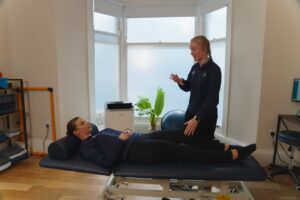
When Should You See a Physio?
If your lower back pain after training persists beyond a few days, repeatedly coming back, affecting your performance, or making you hesitant to train, it’s a strong sign that it’s time to see a physio. Getting a professional assessment allows us to look beyond just the pain itself and identify what’s actually driving the problem—whether that’s movement patterns, previous injuries, or load management.
Catching the issue early with the right guidance is far easier than letting it develop into a long-term problem, and it means you can get back to training with confidence rather than second-guessing every session.
Lower back pain in CrossFit or training isn’t usually a sign that your back is “damaged”; more often, it’s a sign that your body is working harder than it needs to in certain areas. By understanding your movement, identifying imbalances, and following a structured plan, you can reduce tightness, improve performance, and train consistently without fear of the pain returning. If you’re currently dealing with low back tightness after training, the best place to start is by understanding why it’s happening.
Begin with our Self-Assessment Guide and take the first step towards getting back to training pain-free.
This is part of The Resilient Athlete
The system we use to get athletes moving with confidence again. Here is where to go from this article.
Book an assessment and get a plan built around you.
A generic plan only gets you so far. An online assessment finds the root cause with you and tells you exactly what to do next.