You’ve trained hard, recovered from your injury, and yet… your knee pain comes back.
Frustrating, right? You might think it’s because your muscles are weak or your quads aren’t strong enough. But here’s the truth: strength alone isn’t enough.
Even elite athletes who can squat enormous weights still experience knee pain, not because they’re weak, but because their muscles aren’t firing together at the right time.
Why Strength Alone Doesn’t Prevent Knee Pain: Understanding Knee Pain Causes
Most athletes are told to:
- Strengthen weak muscles
- Improve flexibility
- Build stability
- Increase endurance
These principles aren’t wrong, they’re just incomplete.
Imagine trying to optimize a Formula 1 car by only focusing on the engine while ignoring the sophisticated computer systems that control everything. That’s what happens when you just strengthen your quads or glutes without addressing how your nervous system coordinates them.
Even if your VMO (inner quad) is strong, if your soleus, hamstrings, glutes and core are not sharing the load as well as they could, your knee can still bear extra stress during running, squatting, or cutting movements.
Overtraining or overloading the joint can exacerbate this stress, pushing tissues beyond their capacity and causing recurring pain even in a “recovered” knee.
“The strongest athlete isn’t always the most resilient; it’s the one whose muscles work together like a world-class orchestra.” – Dave O’Sullivan, physio & author of “The Resilient Athlete”.
Hidden Knee Pain Causes and Why Pain Returns
Have you ever wondered why your knee hurts even though you haven’t fallen, twisted, or overdone it? The answer often lies in hidden movement inefficiencies.
When your muscles aren’t coordinated:
- The knee absorbs excessive forces it wasn’t designed to handle
- Tiny compensations add up over time
- You feel pain despite being “strong enough”
Additionally, inflammation can set up a painful cycle: micro-damage causes swelling, which alters movement, leading to more stress and more pain, creating a self-perpetuating loop that keeps your knee sore.
This is what we call the Hidden Performance Leak, a disconnect between your body’s potential and how it’s actually performing.
If you’re unsure why your knee keeps hurting, you can try our online knee pain assessment to identify potential causes before seeking treatment.
Signs you might have a hidden performance leak:
- You feel strong in training but something doesn’t feel right
- You’ve recovered from an injury only for it to return
- Movements require more mental effort than they should
- You’ve hit plateaus despite training harder
The Role of the Nervous System
Your nervous system is like the conductor of an orchestra, coordinating every muscle in real time. If it’s not performing optimally:
- Timing between quads, glutes, and core gets disrupted
- Knee stability suffers during dynamic movements
- Recurring pain becomes inevitable as a ‘warning sign’ that something is not quite right.
Think of trying to sprint, jump, or lift weights with misaligned timing: the muscles are strong, but the coordination isn’t there. Something eventually gives.
Rest and planned inactivity are crucial here if your knee joint is irritated giving the nervous system and tissues time to recover.
However the most important component is restoring these coordination patterns to get every muscle around the knee to do its own job at the right time and prevent overloading.
Without adequate rest for an acute irritated knee, the same inefficiencies may often continue to produce pain even when you try to restore the coordination inefficiencies. From our experience, hands on treatment to tissues like the vastus lateralis (outside quad muscle) can often speed this period of inactivity up.
Movement-Related Knee Pain Causes and Recurring Injuries
Common movement issues that keep knee pain coming back include:
- Poor hip-knee-ankle coordination – your lower limb chain isn’t moving efficiently, often after an old ankle injury for example.
- Weak posterior chain activation – soleus, hamstrings and glutes not doing enough work when the foot hits the floor (think sinking a little bit with every step)
- Anterior chain overload – quads taking more load than necessary and never giving the other muscles an opportunity to do more work
- Imbalanced nervous system signals – timing mismatches during complex movements due to top down ‘fear’ or other maladaptive beliefs
These issues are often worsened by underlying injuries. ACL tears, ligament strains, or meniscus damage can alter joint mechanics and timing, making proper coordination even more critical. If these structures are compromised, your knee is more prone to recurring pain from our experience even after conventional rehab if there has not been a specific focus on the coordination levels prior to strengthening.
Even with perfect strength numbers, these small inefficiencies may lead to overuse and micro-injuries that flare up repeatedly. The brain naturally tries to let you know via a conscious experience of pain that ‘something is not quite right’.
What Athletes Can Do About It
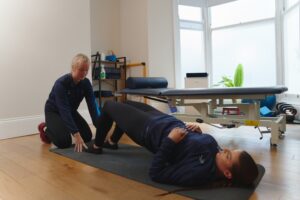
The solution isn’t just more strength. You need to retrain coordination, timing, and movement patterns. Some examples:
- Midfoot Bridge + Hip Shift – improves foot and knee loading
- Slouch – teaches proper hip-knee-ankle coordination
- Single Leg Reverse Plank – strengthens posterior chain and your gastrocnemius and proximal hamstring in functional patterns
Focusing on coordination and nervous system efficiency allows you to train at full intensity without your knees constantly telling you to stop.
Additionally, listening to your body and scheduling adequate rest days may also prevent inflammation from compounding and reduces the risk of overtraining injuries.
Recovery isn’t passive, it’s an active part of preventing chronic knee pain by training smarter not harder.
When to Seek Professional Help
Recurring knee pain may require a tailored assessment if:
- Pain persists despite correcting movement patterns
- You notice swelling, locking, or sharp catching
- You want to accelerate your recovery and prevent future injuries
Our ProSport Assessment combines movement analysis with personalised rehab to address the root cause, not just the symptoms.
Knee pain isn’t just about weak muscles. It’s about how your muscles work together. By retraining coordination, improving timing, incorporating rest, managing inflammation, and addressing underlying ACL, ligament, or meniscus injuries, you can finally break the cycle of recurring pain and get back to training at full intensity, confidently and safely.
Ready to stop knee pain from coming back?
Book your ProSport Online Assessment today or contact us to schedule an in-person physiotherapy assessment at one of our clinics in Huddersfield, Leeds, Denby Dale or Saddleworth for personalised treatment.
FAQs
Why does knee pain keep coming back even after rehab?
Recurring knee pain often comes from hidden movement inefficiencies, overloading the joint, or lingering inflammation. Even strong muscles can’t protect your knee if coordination and timing are off.
How does overtraining contribute to recurring knee pain?
Overtraining or excessive load stresses tissues beyond their capacity, leading to micro-injuries and inflammation. Without adequate rest, this creates a cycle of recurring pain.
This is part of The Resilient Athlete
The system we use to get athletes moving with confidence again. Here is where to go from this article.
Book an assessment and get a plan built around you.
A generic plan only gets you so far. An online assessment finds the root cause with you and tells you exactly what to do next.