
What is back pain?
Back pain is one of the most common musculoskeletal complaints and can be caused by a wide range of physical, behavioural, and stress-related factors.
What Has Caused My Lower Back Pain?
Back pain is one of the most common reasons people visit a physiotherapist, but it’s also one of the most misunderstood. Most people we see at ProSport Physiotherapy in Huddersfield don’t just have back pain once. They have it repeatedly. It settles, then comes back weeks or months later.
If that sounds familiar, the key question isn’t just “what is back pain?” — it’s “why does my back pain keep coming back?”
This post is about understanding exactly what’s driving your pain, so you can finally break that cycle.
The Most Common Causes of Back Pain
Lower back pain can come from several different sources. Sometimes the discs and nerves become irritated, causing pain in the back and down the leg. Sometimes the surrounding tissues become sensitised, creating a lot of pain even with minor movement. And sometimes the lower back muscles are simply doing too much work because something else in the body isn’t pulling its weight.
No matter which tissues are involved, the root cause of back pain usually comes down to movement habits and behaviours; and those habits are shaped by your history.
If you want a deeper breakdown, you can read our full guide on the most common causes of back pain.
Why Your Back Pain Is Unique To You
Two people can walk into our clinic with the exact same symptoms — same stiffness, same location, same triggers — and the reason behind their pain can be completely different.
One might have a previous ankle injury that’s quietly altered the way they move. Another might be affected by how they breathe under stress. Another might simply be overloading their lower back in the gym or during everyday activities.
This is why generic exercises from the internet so often fail. They don’t address your specific cause of back pain.
Why Compensation Strategies Lead to Back Pain
Our movement habits are shaped by everything that’s happened to our bodies over the years. Every injury, every niggle, your body develops small compensation strategies to protect itself. This is completely normal. It’s the reason you don’t need a physio every time you stub your toe.
Over time, though, these compensations stack up. Certain areas, often the lower back, end up doing far more than their fair share of the work.
That’s why people so often “go” their back doing something trivial, like picking a slipper up off the floor. The back isn’t the problem in isolation — it’s been quietly overworking for a long time, and that small movement was the final straw.
At ProSport, we look beyond the obvious. We might be examining your ankle, your knee, your hip, or even your shoulder, because any of these can be contributing to why your lower back is under too much load.
The Back Pain Cycle — And How to Break It
One of the most frustrating things we hear from patients is some version of this:
Pain appears → I rest or take painkillers → it settles → I go back to normal → it comes back.
The reason this keeps happening is because the root cause hasn’t been addressed. The same load is still going through the same area in the same way. Until we change how your body moves and distributes that load, the cycle continues.
Breaking the back pain cycle means finding what’s actually driving the problem — and that’s different for everyone.
Why Your Back Pain Keeps Coming Back
There are usually two main contributors we look for when someone’s back pain keeps returning.
- Previous injuries
Past injuries often change the way we move — even long after the pain from that injury has gone. Research shows that the brain holds onto protective movement strategies well beyond the point of healing. A rolled ankle years ago might still be subtly affecting how you walk today, which in turn puts extra load on your lower back.
- Non-physical stressors
Back pain isn’t purely physical. Stress, anxiety, and emotional load all have a very real impact on how your body functions.
When you’re stressed, your breathing pattern changes. You breathe faster, hold more tension, and shift into a kind of low-level “fight or flight” state. The problem is that your diaphragm — which isn’t just for breathing, but plays a key role in stabilising your spine — stops functioning as efficiently as it should. Your core’s ability to support the lower back is reduced, and the lower back has to compensate by working harder.
Over time, this leads to chronically overactive lower back muscles that are genuinely difficult to relax. It’s something we see constantly in patients with recurring pain.
How Breathing Affects Your Back Pain
This is something we cover in depth — and something most people are surprised to hear about.
Your diaphragm and pelvic floor form the top and bottom of your core. For your core to work properly, the diaphragm needs to move and lengthen freely with every breath. But when you’re in pain, stressed, or bracing in anticipation of movement, most people hold their breath. That tightens the diaphragm, reduces spinal stability, and forces the lower back to pick up the slack.
During my time working with the England Rugby Union team, breathing drills were a regular part of training — even something as simple as blowing up balloons. There’s a very good reason for that. It’s not just about fitness. It’s about making sure the right muscles are doing the right job.
Whether you’re a professional athlete or someone who’s struggled with back pain for years, the principle is the same: restore proper breathing mechanics and you take unnecessary strain off the lower back.
Exercises For Back Pain
The goal of exercise is not to “force” the back into strength.
It is to:
- Distribute load more evenly
- Reduce overactivity in the lower back
- Improve movement efficiency
- Restore natural coordination between body regions
When this happens, pain often reduces because the system is no longer overloaded.
Here’s something that surprises a lot of people when they come to us for back pain treatment: we’re often not trying to strengthen the lower back. We’re trying to help it relax.
When your lower back has been overworking for a long time, it becomes very difficult to switch off. Think of it like holding your fist tightly clenched for hours — after a while, every muscle around it is sending signals to your brain saying “I’m working really hard here.” That creates discomfort, tension, and eventually pain.
So the exercises we give aren’t always what people expect. We use them to activate other areas of the body — the hips, the legs, the thorax — so that the lower back finally gets permission to let go.
Before starting any exercise programme, it’s important to understand what type of back problem you’re dealing with. Our Self-Assessment Guide is designed to help you identify whether your symptoms are more likely driven by movement patterns, mechanical overload, or nerve-related sensitivity, so you can be directed towards the right type of exercise approach.
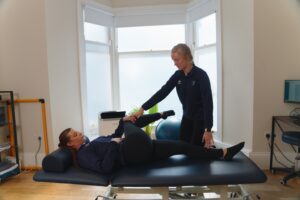
A common mistake with back pain: trying to sit up perfectly straight.
When you sit rigidly upright, your lower back muscles are constantly engaged. That might feel like the “right” thing to do, but it’s actually adding to the load. A slightly relaxed, natural sitting position — not slouched, but not rigid either — allows those muscles to rest.
We want your lower back to do the right amount of work, not the most. And we want everything else — your legs, your core, your upper body — to do its job, so your lower back doesn’t have to compensate for all of them.
Why There’s No One-Size-Fits-All Approach to Back Pain
Every person’s history is different. Their previous injuries are different. Their stress levels are different. Their movement habits are different. That’s why the same set of exercises can work brilliantly for one person and do nothing for another.
At ProSport Physiotherapy, all of our therapists are trained in the same whole-body approach. We look at you as one system, not just a painful lower back. We put the pieces of your story together to find what’s actually driving the problem.
It’s the same approach Dave O’Sullivan uses with England Rugby. The same approach we use with professional golfers. And it’s available to you, right here in Huddersfield.
When to get urgent help
Most back pain settles with the right rehab, but some does not. Get same day emergency care if you notice any loss of bladder or bowel control, numbness around the saddle or inner thighs, or sudden weakness in both legs. Book an urgent assessment rather than self managing if you have unexplained weight loss, pain that is worse at night and unrelated to movement, a fever, a history of cancer, or this is your first significant episode over the age of 50.
Ready to Stop Guessing?
If your back pain keeps coming back despite trying Pilates, yoga, core exercises, or rest — it’s time to take a different approach.
Rather than continuing to guess, the next step is a full assessment. We’ll look at your movement, your injury history, and how your body is working as a whole to find the true cause of your pain. From there, we’ll build a clear, personalised plan to get you out of pain and back to doing what you enjoy.
If you’re sceptical because you’ve already tried a lot, that’s completely understandable. But that’s also exactly where the right assessment can make all the difference.